

All charged up
-
- from Shaastra :: vol 05 issue 05 :: May 2026
A nanomaterial promises faster charging and smoother energy flow.
Researchers in Pune have developed an advanced nanomaterial for storing electrical energy in devices such as supercapacitors, which are designed to charge and deliver power rapidly. Conventional supercapacitors, widely used in electric vehicles, portable electronics and backup power systems, charge rapidly but tend to have a lower energy storage capacity than batteries. Scientists worldwide have therefore been searching for smarter electrode materials that can boost the energy-storage capacity of supercapacitors.
It rapidly accumulates charge on its surface, and also behaves partly like a battery.
Now, a research team led by Shrikrishna D. Sartale and Bhalchandra S. Pujari at Savitribai Phule Pune University has created tiny ribbon-like structures, known as nanobelts, from lithium vanadate (Li2V6O13). Each nanobelt is about 60 nanometres wide, roughly one-thousandth of a human hair.
Because of their long and ultrathin shape, these nanobelts provide ions and electrons with short, direct pathways through the material. This enables faster charging, smoother energy flow and lower energy loss as heat (bit.ly/lithium-vanadate). The team synthesised the nanobelts using a hydrothermal process, essentially "cooking" vanadium oxide and lithium sulphate in water under pressure at 180° Celsius for two days.
"Lithium vanadate has been made earlier, but this single-step process is unique and is probably responsible for its excellent properties," says Tanuja Shinde, a doctoral student in Sartale's laboratory. "This is the first time the material has been explored for supercapacitor applications."
The researchers found that the material simultaneously stores electrical charge in two different ways. Like a conventional supercapacitor, it can rapidly accumulate charge on its surface. But it also behaves partly like a battery: lithium ions can slip in and out of its layered crystal structure, storing additional charge within the material itself. The free movement of electrons is enabled by the presence of vanadium ions in multiple charge states.
The researchers found that lithium acts not only as a structural support that prevents the material from degrading during repeated charging cycles, but also as an electrical booster that helps the charge move more efficiently. The hybrid gives it the speed of a supercapacitor and some of the energy-storage advantages of a battery.
Pujari and his students also conducted quantum-mechanical simulations to understand why the material worked so well at the atomic level. They found the material had a high density of electronic states near the Fermi level — the top energy state that an electron can occupy at absolute zero temperature — giving it a theoretical maximum capacitance of about 1,600 farad/gram (F/g).
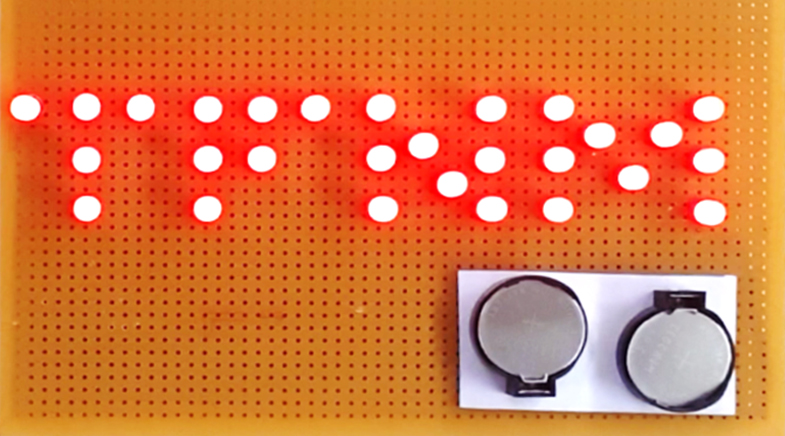
The electrode the scientists built achieved 623 F/g and retained 85.6% of its capacity after 10,000 charge-discharge cycles. They also built a small coin-cell device that powered 28 LEDs and delivered an energy density of 55 Watt-hour/kg. "Our simulations showed that quantum capacitance, too, played a role in its superior performance," says Snehal Shinde, a research student in Pujari's lab who carried out the quantum simulation studies.
Tiju Thomas, Professor in the Department of Metallurgical and Materials Engineering at the Indian Institute of Technology Madras, points out that the "scientifically interesting" work moves beyond the traditional view of electrochemical energy storage as merely an ion-diffusion problem. "Instead, the authors link charge-storage behaviour to quantum-level electronic structure. This is in keeping with an increasing quantum-informed design approach across many technologies," he says.
From a fundamental science perspective, it is an interesting conceptual shift, says Thomas. "From an engineering standpoint, however, translating such a nanoscale performance into commercially deployable systems remains a major challenge," he observes. He adds that there will be many specific questions about vanadium sustainability, lifecycle footprint, scalable nanomanufacturing and long-term cyclic stability under realistic operating conditions. With lithium and vanadium in the mix, cost competitiveness will also present a challenge, he says.
"The real significance of this work lies less in immediate commercialisation and more in how it advances the mechanistic understanding of a potentially important new family of energy-storage materials," Thomas stresses.










For a happy birth day
Indian researchers are bringing the human touch to handling stillbirth.

Have a
story idea?
Tell us.
Do you have a recent research paper or an idea for a science/technology-themed article that you'd like to tell us about?
GET IN TOUCH