

Going with the grain
-
- from Shaastra :: vol 05 issue 05 :: May 2026
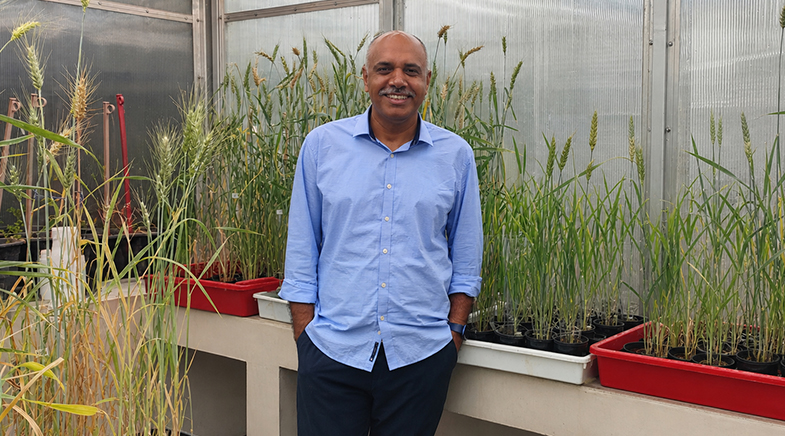
Gene editing boosts iron content in wheat cultivars.
A new wheat variety fortified with iron may one day help address the problem of anaemia in India. Researchers at the Mohali-based BRIC-National Agri-Food and Biomanufacturing Institute (NABI) have successfully edited wheat cultivars, and almost doubled their iron content.
According to a recent study, 69% of children under 3 years of age are anaemic, as are 51% of schoolchildren, 53% of people aged 19-59, and 52-68% of senior citizens (bit.ly/anemia-India). Iron biofortification of crops distributed through the government-run public food distribution system is seen as a way to raise low haemoglobin levels. Wheat, eaten widely, is a good candidate for fortification.
Pandey aims to increase iron and decrease phytic acid, which inhibits iron absorption in the body.
To achieve this, the team led by Ajay Kumar Pandey catalogued the genes that regulate iron uptake, distribution, storage, and utilisation in wheat, and then zeroed in on Hemerythrin RING Zinc finger (HRZ) proteins that negatively control the plant's iron content. It developed a CRISPR cassette that, if inserted in the wheat genome, precisely targets and disables the HRZ genes. The next challenge was to insert this cassette into the plant or transform the wheat plant with it — a laborious process with low success rates. "Indian wheat varieties are not easy to transform. And even if you can transform them, they may not regenerate," says Pandey, Scientist G at NABI.
So, they tried a new approach. They attached a GRF4-GIF1 chimeric protein — a developmental regulator — that acted as a booster, helping the edited cells regenerate into healthy, full-grown plants. With this, they achieved 6.4%-8.8% regeneration efficiency in the wheat cultivars Fielder and C-306, which otherwise have low regeneration efficiency.
The team then tested the iron content in the edited plants and found that in the Fielder cultivar, it increased from 24 ppm in non-edited plants to 36-45 ppm in edited plants; in the C-306 cultivar, it increased from 27 ppm to 38-42 ppm. The results of this study have been published in the journal Plant, Cell & Environment (bit.ly/iron-biofortification). As these edited plants are transgenic because the Cas9 protein of the CRISPR cassette is still present in the plant system, Pandey aims to grow these plants further and select a wheat plant that's free of the CRISPR-Cas9 protein but has a high iron content. Such a plant can then undergo further field trials and eventually be used for biofortification.
Pandey has other plans, too. He aims to increase iron and decrease phytic acid, which inhibits iron absorption in the body, in a single wheat plant, ensuring that a person eating wheat not only takes in more iron but also absorbs it well.








Blood vs blood
The discovery of different blood groups made transfusions safe.

Smart materials inspired by nature
From squids to leafhoppers, mimicking biological systems helps researchers develop sustainable composite materials and coatings.
Have a
story idea?
Tell us.
Do you have a recent research paper or an idea for a science/technology-themed article that you'd like to tell us about?
GET IN TOUCH